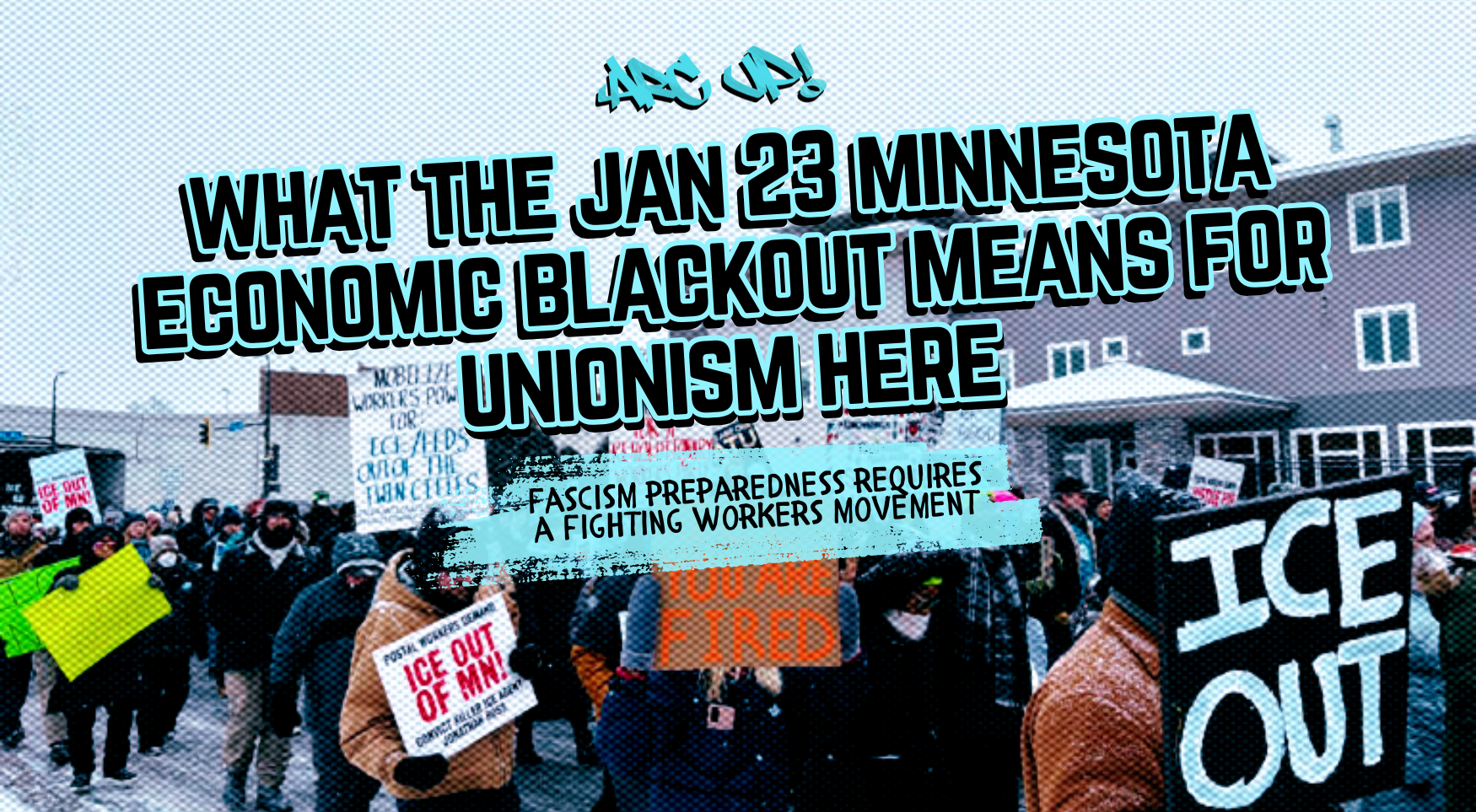
Image by Isabela Escalona from Workday Magazine, showing “The crowd of over 200 union members and allies marched down Lake Street to the block where Renee Good was shot and killed by ICE agent Jonathon Ross a few weeks before.”
Since the start of 2026, 8 people have been murdered at the hands of U.S. Immigration and Customs Enforcement (ICE) under the Trump regime. This includes those who have been directly executed on the streets, and those who died due to abuse and medical neglect in custody. In Minnesota, ICE abducted five-year-old Liam Ramos and his father, shot Julio Sosa-Celis in the leg, and murdered Renée Good and Alex Pretti. These media flashpoints, along with locals defending against abductions in their neighbourhoods, kicked off organising for ‘ICE Out of Minnesota: Day of Truth & Freedom‘. An estimated 50,000–100,000 people turned out in the streets for a one-day shutdown of work, school and shopping on January 23rd. Was this a general strike as it’s been described? And what can we learn from this as we ramp up the fight against growing fascism here?
The original call for mass action came at least 10 days before from a coalition of faith, NGO and community leaders, with major unions signing on later. Despite broad endorsement, union leadership did not call for a formal ‘general strike’, which is the persistent language seen on mainstream media and social media platforms. In seeking to work around no-strike clauses that are commonplace within collective bargaining agreements, unions indirectly encouraged members to participate by individually citing safety reasons or calling a sick/personal day. A similar tact has been taken by Australian unions that want to simulate strike action without going through constricting legal procedures to formally declare a strike, and more importantly, without breaking the law. But as we know, fascists in power don’t follow the law.
While it seems not to be within the union bureaucracy’s interests to break the law despite the situation in the US, there has been a promising push by rank-and-file workers for the day of action. Teachers, hospitality workers, bus drivers, healthcare, airport, office workers and more organised to pressure their employers into closing or reducing operations, especially on a heavy snow day with subzero temperatures. While these workarounds do indicate to us that January 23rd isn’t really a general strike in the formal sense, it’s still moving to see so many working people fighting against racialised state terror, and the surge of interest in general strikes as a potent weapon. It also shows that unions are a clear defence mechanism against tyranny. Certainly, armed struggle against over-funded paramilitary, military and police forces would be a non-viable strategy for movements in the US at this time.
In terms of outcomes from January 23rd and 30th, there is not much in terms of kicking ICE out. For the nationwide general strike called 5 days before the 30th by a coalition of Black student organisations, unions did not sign on. There are ‘concessions’ made by the state like the replacement of Greg Bovino, Border Patrol chief, even Trump claiming they will ‘deescalate a bit’. The latter is unlikely to be true as there are reports of continued ICE raids, surveillance, harassment of immigrants and those ‘impeding’ law enforcement. Democrats remain out of touch and likely to appease Trump’s demands. However, a welcome move sees tenants from the Twin Cities launching a tenant union, citing that they need to band together to protect each other.
In Minneapolis there is a legacy of class struggle beyond the workplace—from the 1934 Teamsters strike that organised across unions, the unemployed, and communities against police and paramilitary, to the unsanctioned walkouts and workers refusal to help cops during the 2020 George Floyd Rebellion. What we find most interesting in this context, is that there has also been 10–15 years of organising in Minnesota to align union contracts and community demands, amongst some unions, tenant groups and community organisations. This led to what they call the Minnesota Model, where they’ve won “free school meals and driver’s licenses for undocumented immigrants; getting Amazon to negotiate with workers for the first time; a $15 minimum wage (with proposals to bring it up to $20); so many union contracts it’s hard to count, for janitors and tenants and teachers.”
As we hear about unions in Minnesota with deep ties in multiracial working class communities, being pushed to stand up for workers being disappeared or killed, we can think about the need for us to seriously address the fascist threat growing in ‘Australia’. With immigration crackdowns, all workers’ conditions are eroded and unions cannot afford to ignore this. Our unions will either fail to rise to fight fascism, or they’ll facilitate work stoppages necessary to bring society to a halt to defend all communities facing racialised state terror.
Fascism preparedness requires a fighting workers movement
1. Member control of unions is a must.
Union affiliation with the Labor Party must be challenged. Labor and Liberal are both funded by some of the same interests behind the US fascist takeover (like GEO Group, Serco, MTC), and Labor will fail spectacularly to oppose their donors when it matters. Expect Labor to act like the Democrats in America, as they call for body cams for ICE agents as they trample human rights, abduct, kill and disappear people. Their strategy has been to tell ICE to ‘fuck off’ and appear staunch in the media while continuing to approve funding for Trump’s paramilitary. The Labor Party remains allied with Israel and has overseen refugee detention, some of the most brutal in the world. It also sold out worker militancy for control of the unions that are now used to campaign for Labor’s re-election. Labor will enable fascism because they are structurally incapable of posing a meaningful threat to it.
Therefore, rank-and-file unionists will have to be the ones to to demand their unions take a meaningful stance and preventative measures against fascism. They will have to contest complacent and complicit Labor leadership in their unions, establish democratic processes, accountable positions, and push fights beyond the parameters of protected action. If the biggest threat to worker safety and stability is deportation to death, then anti-fascism is union business. You’re not protected at work with a good EBA if jackbooted thugs can raid your workplace, or rip you from your bed at night.
2. Unions must fight for free speech and put anti-fascist, pro-union arguments forward
As American oligarchs take control of social media and manipulate algorithms, this affects our ability to freely speak and spread our ideas online. An education program that is anti-fascist should come out of the union movement. Funds from all unions should be injected into a project that can challenge the deep-pocketed right wing dehumanisation campaign started in the US and spread here. We must make anti-scapegoating, pro-migrant, pro-Indigenous and pro-union media that can offer meaningful counter-points to the right’s arguments. A pro-union view needs to made public, and accessible to all workers. It also needs to enter into debate in the spaces the Right have monopolised.
3. Unions must stand with struggles outside the workplace.
There may come a time when unions strictly focused on fighting for better EBAs are forced to accept reality fast—that their members are being denaturalised or having their rights ignored. If the US (and broader history) is anything to go by, unions will be called on to protect their members from attacks coming from the government and fascist forces. Therefore, the quicker unions embrace a mode of struggle broader than just the workplace, the better. The brand of lawfare pursued by US and Australian unions, of exploiting holes in anti-union law to maximise workers power legally, will not save workers if fascists take power.
4. Above all, workers need to be connected across workplaces, unions and industries.
Every worker should be a member of a fighting union as protection against fascist incursion. It’s no good if one union at a time downs tools—we need all workers to strike until racialised state terror ends. If we had it our way, that would start now in solidarity with First Nations people, refugees and migrants now. In ‘Australia’, Border Force raids and deportations are already happening to undocumented workers and migrant sex workers. We need to continue cultivating relationships between unions, community groups and the organised left. Not one where activists make demands of unions from the outside, but genuine, true solidarity where we back each other’s fights.