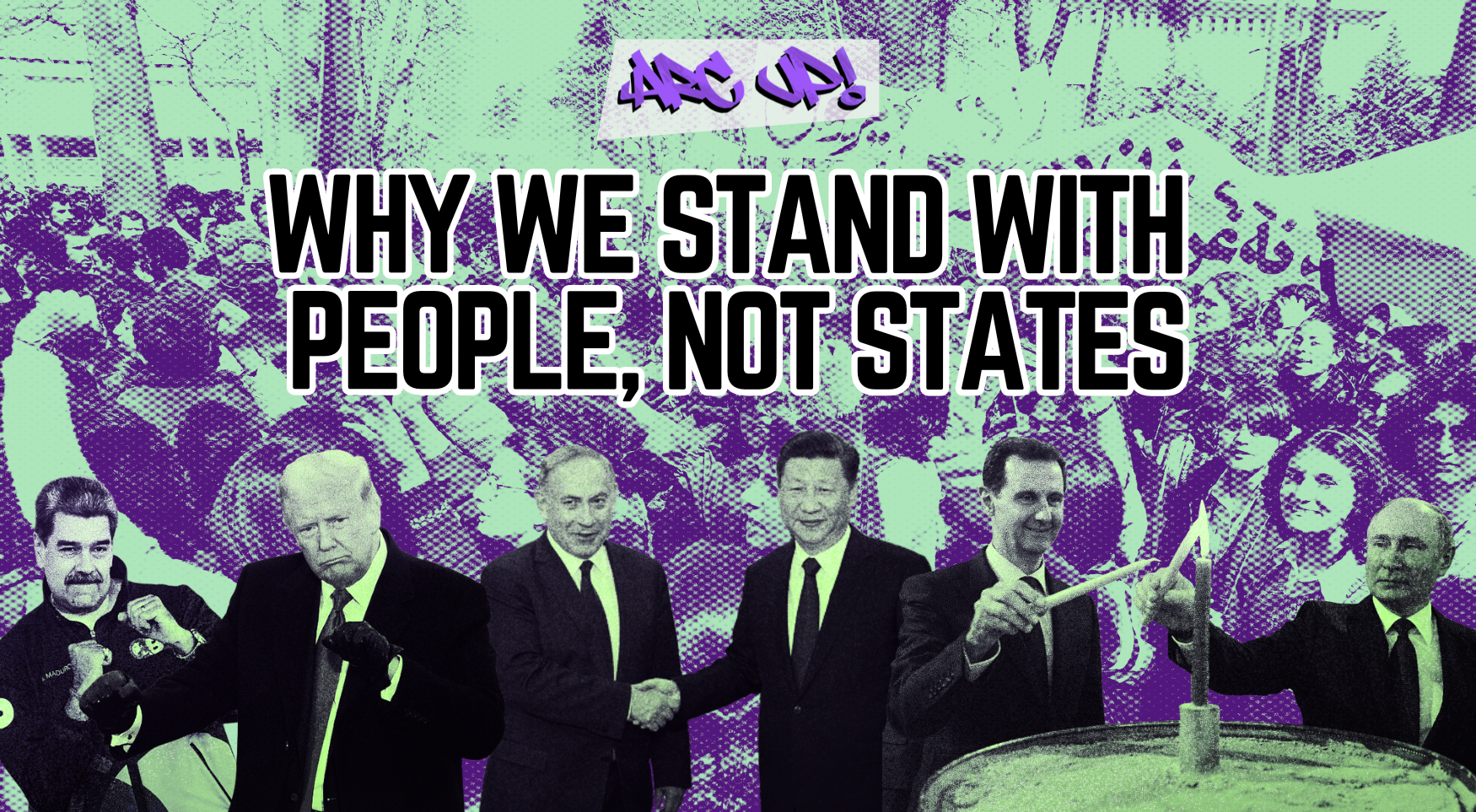
Why do parts of the left butt heads on Venezuela, Syria, Ukraine and most recently Iran? Some leftists are supportive of resistance against both state oppression and imperialism. Others come out in vocal support of state bureaucrats and their right to repress protests, conflating all local resistance with the activity of the CIA or Mossad. For the latter, the implication is that people in these countries and in the diaspora can have no credible grievances—at least not grievances that can be resolved while dominant imperialist interests pursue agendas in those countries. How do we understand why parts of the left see these nation states as a part of the resistance to global capitalism? And how does it point to antagonistic strategies pursued by different parts of the left today?
On internationalism
Anarchist Communists, like many Marxists, believe that workers hold the power to enact systemic change. Once upon a time, workers in ‘Australia’ were protected by financial regulations and tariffs that prevented capitalists from moving production overseas to undermine wage disputes. This allowed workers to bargain for higher pay without risking losing their jobs entirely. Since capitalists deregulated finance, capital now moves more freely around the world, ending the days of protectionist unionism that could afford only to worry about national workers interests.
As the Anarchist Communist Federation explains in their article outlining the Anarchist position on internationalism: “Production chains are globalised to the point where a product as simple as a frozen meal may cross several borders before it’s sold. Beans from Egypt, spices from Türkiye, and meat from Australia are cooked in factories in England, packaged in plastic from China, and sold in a supermarket in Ireland.”
To account for globalised capitalism, any workers movement must be global as well. This means adopting an internationalist orientation to struggle, that seeks to coordinate strikes or bans at economic chokepoints across continents to realise demands. For example, to end Israel’s genocide in Palestine, workers internationally would need to execute a labour boycott to halt all possible supplies Israel requires to commit genocide. An international workers movement would also ensure the lack of strong unions in one context can’t be used against workers in other contexts. In an imperialist world, where capitalists operate globally, we too must coordinate workers activity globally to create the leverage we need to win.
Understanding Campism
There are some on the left that propose a path diametrically opposed to internationalism—a project of state-building. To understand what this is about, we have to look at where this strategy arose in history, and what it entails. After the 1918 German Revolution failed and left the Russian Revolution isolated, the strategy of the USSR leadership pivoted from internationalism to a project of building ‘socialism in one country’. This meant the Russian state moved to operate capitalism, seeking trade and military support with other allied states. In other words, not socialism at all. Under Stalin’s control, the USSR would attempt to build an ‘anti-imperialist’ camp of allied nations that could rival dominant imperialist powers like Britain, France, the US, and Japan—forces that might destabilise the USSR. Hence the term ‘campist’.
This strategy wasn’t considered seriously before that historical moment. To survive their isolation, many felt that the Russians had chosen to abandon the revolutionary goals of communism altogether. While campists prefer to be called ‘Marxist-Leninists’, some on the left contest that moniker. Though Stalin took cues from Lenin’s work ‘Imperialism, the highest stage of capitalism’, some maintain that Lenin’s position was that workers movements must collaborate globally to fight imperialism, not that states should form permanent power blocs and operate capitalism until they can eventually muster the military might to defeat dominant imperialists. If the German revolution hadn’t been a near miss, we might live in a timeline where this strategy never existed.
With control of the USSR, Stalin set out to industrialise Russia, open the markets to international trade, and buckle down to survive economic sanctions imposed by America and its allies. He would offer conditional support to the governments of Mongolia, China and Eastern Europe, though Stalin always sought subservience to his leadership. As the torch-bearer of world ‘socialism’, Stalin brought the world’s communist organisations under his directive through the Communist International (Comintern). From the top-down, Stalin enforced obedience to Moscow over local realities and needs of the working class around the world. From the early days of the Communist Party of Australia, their members would take action influenced by USSR directives, as well as having their party reorganised and leadership groomed by the USSR. When Moscow sneezed, communists in the West really did blow their noses.
Workers Power?
For ‘socialism in one country’ to be successful, workers power simply couldn’t exist. Except of course in the rhetoric of state bureaucrats and from the obedient mouthpieces of world Communist Parties. Stalin’s five-year plan to industrialise Russia led to worker coercion, wage suppression, forced labour, criminalisation of strikes and absenteeism. Worker opposition was labelled counter-revolutionary, and trade unions became tools of labour discipline not workers power. All Stalin established was that a nation state can survive times of economic isolation and industrialise. But this cost the complete political agency, and in the case of purges and invasions, the lives of large numbers of Russian and Polish working classes, as well as other regional and ethnic groups.
Similar to Stalin, Mao’s project of industrialisation required the decimation of the Chinese working/peasant class. To build the power of the nation to survive economic isolation, they needed exports to survive. While peasants starved, they were denied the grain they grew, leading to a catastrophic famine and tens of millions of deaths. People working long hours coupled with poor nutrition made hard labour and production quotas deadly. ‘Struggle sessions’ were framed as forums for self-criticism, but led to public humiliation, beatings and murders. Moreover, the CCP leadership authorised the 1950–51 “peaceful liberation” of Tibet, and a “punitive expedition” to invade Vietnam in 1979.
In 1960, the USSR allied with Fidel Castro, who submitted the Cuban working class to a similar project of hyper-exploitation in the name of economic development. In this case, the ‘ten million ton harvest’ of sugar cane for export. The anarchists that were a dominant force in the workers movement before Castro took power were cast out, exiled, imprisoned or killed with other dissident workers as the unions came under state control. The claim that nearly all workers were unionised was a neat piece of rhetoric, repeated by Communist Parties worldwide to signal a healthy workers’ democracy in Cuba. In practice, however, the unions functioned as sites of control and subjugation, facilitating the rapid socialisation process undertaken by campist leaders. Castro also personally sent Cuban troops to Angola in 1975, and there is evidence of Cuban involvement in the 1977 Angolan MPLA purge with death counts ranging from 15,000 to 90,000 of mainly poor, Black Angolans.
The violence, domination and tyranny under these states was bad enough for the reputation of communism around the world. But the dishonesty, denial and selective focus of propaganda coming out of the international left cost communism yet more credibility amongst the working class internationally. When Stalin’s purges were broadcast by his inner circle in 1956, it resulted in mass exoduses from communist parties around the world. The Soviet mode of organising was so mistrusted that it contributed to creating a new era of the left, not only of anti-communism but anti-organisationalism as a whole. An era we’re arguably still living through, and an era that can’t be undone with more vicious lies, denial and narrative control. The cruel legacy of campism cannot be put back in the bag, it can only be abandoned wholesale.
The role of propaganda
While the original purpose of the Comintern was to coordinate international communist activity toward a global working class revolution, its role was reduced to being a mouthpiece for repeating USSR propaganda. Organisations that deviated were disciplined. Communist Parties were given directives to justify Stalin’s purges, deny famines, explain away show trials, attack critics and dissidents as imperialist agents or fascists. When Stalin invaded eastern Poland, it was to be propagandised as a defensive necessity and a ‘march of liberation’.
Even in the face of undeniable violence and death, communists were taught to set aside Stalin’s actions, because weakening the USSR would only help its enemies. This included Nazi Germany until Stalin allied with Hitler in 1939, leading to communist parties defending Stalin’s allyship with Hitler as strategically necessary to protect the socialist project. As you might imagine, the move to ally with the Nazis was a hard sell for the parties actively involved in campaigning against fascism at the time. After Stalin’s pact with Hitler ended, and the USSR entered World War II, the Communist Party of Australia supported increased industrial output for war and adopted a no-strike policy. Stalinist union officials accused members striking of ‘helping Hitler’.
The USSR’s repression of the Anarchists during the Spanish Revolution in 1936, and its later crushing of the 1956 Hungarian revolution with tanks (hence ‘tankie’), resounded internationally. To principled communists, it demonstrated that independent working-class uprisings had no place within a campist reality. It was subservience to the singular world leader of communism, or it was death. This could not have been more of a departure from communist ideals and strategy. Yet there were still Communist Parties defending and sanitising these actions, which resulted in more and more revolutionaries hanging up their party membership and abandoning hope in communism altogether.
While Mao didn’t enforce his political line quite like Stalin did, it was treated as gospel by eager authoritarian communists toeing the Beijing line. These communists dutifully blamed deaths under the party on natural disasters like floods, droughts or bad weather. While grain was forcibly requisitioned during periods of starvation, any talk of famine was labelled ‘anti-socialist’. When information couldn’t be denied, some would claim that Mao didn’t intend for people to starve, or that his party withheld information from him.
The Cuban anarchist exiles also endured a protracted and deep-pocketed propaganda/smear campaign established with USSR support and training. This was to discredit the working-class militants not loyal to the party. Frank Fernandez outlined much of the brutality under Castro in his book. He speaks about how strikes were crushed, leaders jailed, deported or killed. Even Anarchist groups like the FAU in Uruguay supported the Cuban government as it was exiling and disappearing anarchists due to its successful propaganda campaign. But even the most well-crafted campist propaganda campaigns are a bubble doomed to burst with survivor testimonies and documentation, demonstrating another element of the folly and futility of authoritarianism and the campist strategy.
The US has supported anti-communist governments, proxy conflicts and engaged in covert CIA operations and direct wars to stave off the spread of ‘communism’. Related anti-communist propaganda has been prolific in its fabrications. Cuban biological weapons threats, Chinese mind-control techniques, overblown USSR missile numbers, to name a few. Unfortunately for the campists, their legacy of violence speaks independently of US attempts at counter-insurgency. They have historically viewed the denial of their own violence and strategic missteps as crucially important in fighting imperialism. While the US hate is justified, continuing the Cold War tradition of deflecting all responsibility just obscures the flaws in the campist strategy—that the working class, and its economic leverage, is expendable, while capitalist states are not.
Campism today
While avoiding criticism of non-western states typically remains in service of not manufacturing consent for the US to invade, what’s missing is a convincing analysis of whether the current US administration is engaging in the same processes of manufacturing consent as in the Bush era or during the Cold War. The left today has no meaningful sway over the stance of the global working class that would make Australia or the US take pause at all. We have no real power in the unions, even the political parties created to represent working-class interests are indistinguishable from the far-right parties today. The power the left has to green light invasion appears vastly overstated.
At the very least, policing small left-wing group articles/social media posts in ‘Australia’ and elsewhere seems unlikely to have been the difference between Trump invading Iran or not. But if this logic was applied in reverse, are campists manufacturing consent for the Iranian military to mow down protestors when they insist grievances are raised not by Iranian people but solely Mossad or CIA agents? ‘Colour revolutions’ are easier to carry out when the working class has widespread grievances already. Brutal governments just make destabilisation easier—to blame Iranian protestors for their own fate is beyond putrid.
Campists will often beat around the bush, talking about how serious they are, how they’re not idealists or liberals like the rest of the left. They will cite the horrors of a world under the totalising control of US interests, but in their fervour they fail to put forth a strategy truly capable of preventing this. Instead their strategy relies on huge sections of the working class living and dying under authoritarian states as a defense against imperialist encroachment. If the working class revolts in a way they don’t like, they’ll get to work sanitising state violence and ignoring statements by working class organisations on the ground. But to what end, besides gaining the mistrust and supporting the decimation of the same working-class communities that must be organised to shut down economic chokepoints against imperialists? Peel back the rhetoric and PR-speak and a rotten strategy reveals itself.
Campism is unprincipled
Campists today are either too lost in the sauce to realise their radical culture is based on lying for dictators, or they realise that they are lying and they’ve justified why it’s important. Either way, this behaviour should’ve been left in the Cold War. It is not the behaviour of principled revolutionaries pursuing a strategy capable of convincing the masses to adopt communist ideas.
Even if we were to concede that now isn’t the time to critique executives of countries being invaded by the US, surely it’s counter-productive to talk about the ‘sovereignty’ of fascist leadership or to deflect testimonies about state violence and executions with whataboutisms and strawman arguments. The campists of yesterday caused irreparable damage to the prospects of world communism, but their heroes were at least draped in red. Today’s campists are left to defend Assad or the Iranian state that engaged in the mass executions of communists and trade unionists. If these are the players on your ‘team’, you might want to revisit the rules of the game.
A basic analysis of capitalism demonstrates that there would be no shortage of ruthless imperialists to fill any void left by the defeat of US imperialism. Just look at the imperialist legacies of some of the campist leaders. The fact campists spend so much time justifying why Russia invading Ukraine isn’t imperialism, or how China has no imperialist/neocolonial aims in Africa says so much about their ideology. What a cruel fate to have to defend and bend reality to run PR for capitalist nation states that clearly don’t share your goal of world communism.
While the US ruling class are rabid imperialists that must be smashed, and while we maintain a revolutionary defeatist position regarding our own government’s imperialist endeavors, it should go without saying that imperialism will never be defeated with a strategy that preserves and strengthens capitalist modes of production and suppresses working-class resistance wherever it shows up. After the Sino-Soviet split, the dissolution of the USSR, an undeniable legacy of violence, invasion, and mass exoduses from communist parties worldwide, for campists to still act like they are the sole defenders of world socialism is as pathetic as it is mistaken.
Internationalism is the only answer
For Anarchists and other revolutionaries interested in building an international workers movement capable of smashing global capitalism, we’d first need to accept that other peoples’ struggles actually exist and aren’t reducible to CIA operations. Critically, an international workers movement capable of defending against imperialism will not be built by systematically destroying independent workers organisations around the world, for the purpose of building the power of capitalist states run by a handful of bureaucrats seeking self-preservation. Similarly, expecting that sections of the global working class would take one for the team and tolerate violent dictatorships, either ‘communist’ or fascist, for some poorly conceived promise of a future world should be discarded as a literal impossibility.
For internationalists, of Marxist and Anarchist varieties, the axis of resistance cannot be capitalist, fascist or theocratic states, and for Anarchists, it can’t be the state at all. Resistance and power to fight imperialism is born of the free organisation of working and oppressed peoples. If we want to resist capitalist exploitation, imperialist intervention or clerical fascism, workers need to be empowered, highly organised, in control of their unions and able to coordinate action internationally. This is the program of Anarchist Communists today. Enabling, justifying, ignoring, erasing or carrying out the oppression of the working class anywhere takes us down a road directly opposed to this goal. While campists may call us CIA operatives or idealists, the true counter-revolutionaries and idealists are those that believe the decimation of the working class could ever give way to a communist future.
Arc Up welcomes all those who are questioning campist ideas to explore alternatives in our education series on class struggle anarchism. Click here to sign up.