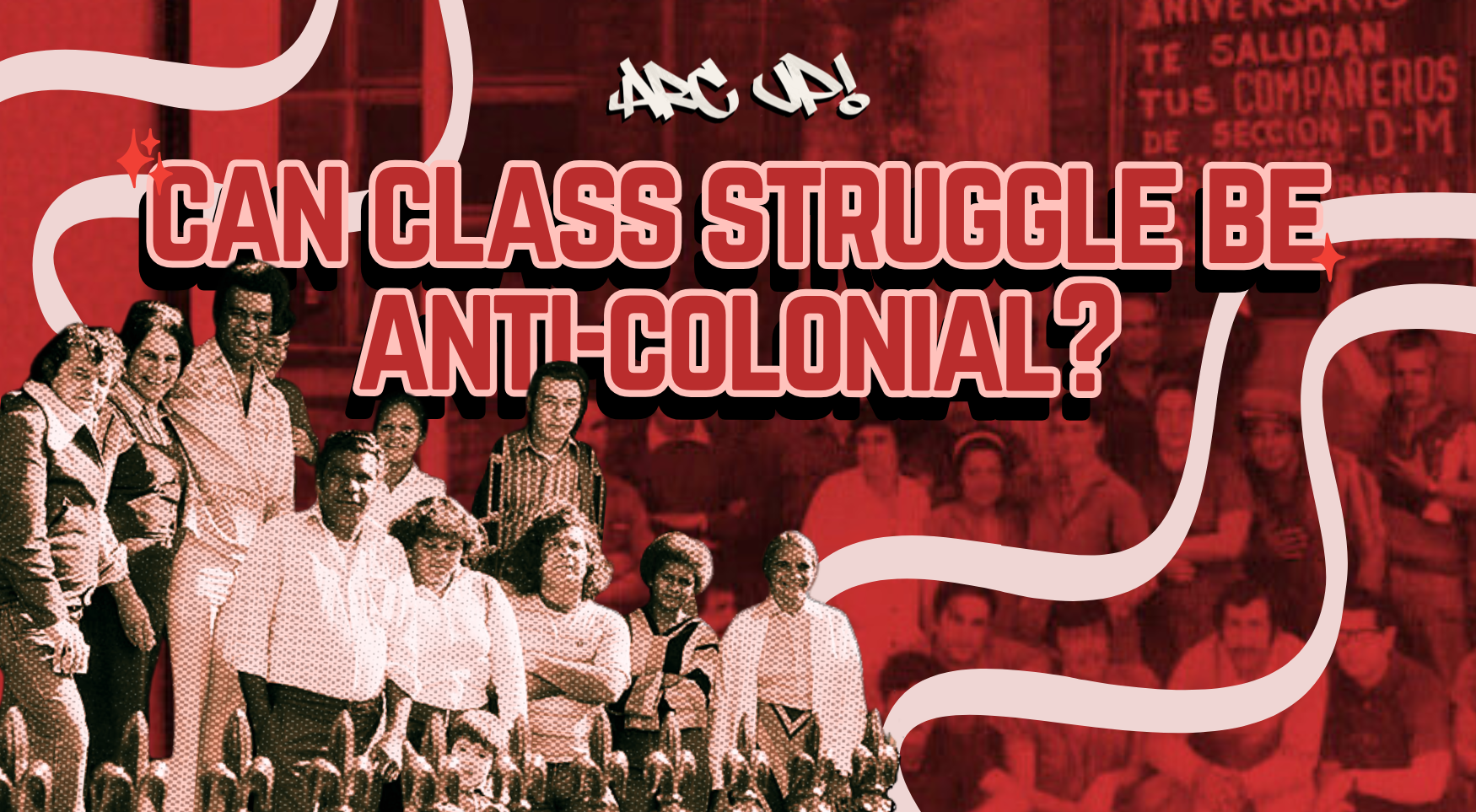
Front image shows Aboriginal staff and students supporting Utah miners outside Tranby College, 1978. Used with permission from Tranby Aboriginal Co-operative. Source: Around the Meeting Tree: Tranby History 1980-2000.
Back image shows FUNSA workers, including FAU members during the 1960s. The FAU had a massive influence on FUNSA, holding many of its leadership positions. Source: Red & Black Notes.
Fifty years ago, major tendencies on the left fought tooth and nail for influence within the unions. Today, many leftists look elsewhere for power to realise social change. Seeing unions remain dutiful to the Australian Labor Party (ALP) and fail to lift a finger for Palestine has reinvigorated those interested in class struggle to push harder for rank-and-file militancy and control of their unions. Some, however, see this low point of unionism as a reason to turn away from class struggle altogether.
Influenced by the Marxist-Leninist ‘two-stage’ theory of revolution, a growing section of the left believes that colonialism and/or imperialism must be defeated globally before the fight of workers against capitalism can ever be successful.
In this conception, the Global South, nation states and all, are cast as the revolutionary subject. The Global North then, is its ruling class, made up of both colonisers/imperialists and their agents—white/settler working-class populations that are considered as unlikely to give up their positions in the world hierarchy, as capitalists are to give up control of the means of production.
From this position stems critiques that unions are doomed to be tools for maintaining the status quo, that class struggle is insufficiently revolutionary and incompatible with the liberation of those living under colonialism and imperialism. If this analysis were true, we would be left without a revolutionary strategy applicable to ‘Australia’. If we can’t trust most of the population to be meaningfully revolutionary, then the task is to wait to be liberated by those who are.
While there is a strident history of First Nations workers struggling for land and self-determination with the Pilbara, Gurindji, Torres Strait Islander Maritime Strike etc., this article will primarily focus on whether dominant sections of the working class are capable of taking up anti-colonial and marginalised struggles, making class struggle either capable of ending colonialism on this continent, or not.1
Fighting imperialism/colonialism before capitalism?
Rejecting the two-stage theory of revolution, internationalists like Anarchists know that colonialism and imperialism are tools of modern capitalist expansion, and can only be ended with the destruction of global capitalism. Even the so-called ‘socialist’ projects that maintained capitalist modes of production proved that imperialism reproduces itself as long as capitalism remains standing. The USSR and other ‘socialist’ states have viciously invaded and conquered their neighbours to expand their economic reach.
Colonialism is continued through capitalist production every day. Mining and fracking industries push Indigenous communities off their land for profit. The overpolicing of Indigenous people benefits the state and prison companies. To halt these processes, we must build a workers movement capable of acting at crucial points of economic leverage to refuse work and demand transitions away from destructive industries and work practices. This isn’t a national workers movement, but one that is internationally connected and able to coordinate globally until the global capitalist system is smashed. The workers organisations necessary to conduct this revolution would take over production within a classless socialist society. Sovereignty able to be fully realised, any treaties developed by Indigenous nations would flow upward into mutual obligations followed in the lives and work of those who lived and navigated those lands.
The foundational position of internationalists is that more ‘privileged’ sections of the global working class are capable of solidarity with more oppressed sections, and that it is within all of our material interests to cooperate and lend our power to each other’s struggles and the common goal of ending capitalism. In fact, the history we’ll look at below shows that it is far less likely that any sub-section of the working class will achieve liberation for itself without a program of solidarity that reaches across the class, addressing all social issues faced by all people. In this conception, defending against attacks on the marginalised isn’t optional, it’s a crucial element of working class self-defense and an integral part of a credible revolutionary strategy.
Is anti-colonial class struggle possible here?
Where some focus on racist union history to argue against engaging in class struggle, others fire back citing instances of genuine anti-colonial solidarity within unions across history. Simplistically seeking anecdotes to confirm biases is a bad way to address genuine skepticism. As we’ll discuss, both racist and anti-racist union history exists in ways too substantial to ignore. The best path forward is to understand what led to unions taking on exclusionary, racist policies, and what conditions then produced the instances of true anti-colonial class struggle. This might help point us toward a strategy of class struggle today.
In the late 19th century, Australian trade unionism was marred by racism. The White Australia Policy heralded by the ALP-led unions was “initiated by the British ruling class, emanating from the Colonial Office in London”. Unions like the NAWU and the AWU barring Indigenous and non-white immigrant workers from membership at varying locations and time periods, from between the 1880s till 1960s. First Nations workers were excluded from equal rights and pay up till late 1960s, Melanesians forced into blackbirding were deported in part due to union agitation against the importation of ‘coloured labour’, and unions ran an anti-Chinese campaign during the 1878 Seaman’s Strike. Instead of banding together as a class against bosses, a largely reformist union movement opted for excluding racialised workers instead.
Into the 20th century, communists became a substantial force in the unions. There were two main political tendencies that sought to broaden the focus of trade unionism from workplace issues to social issues like land rights. Both Marxist-Leninists and Internationalists attempted to achieve the “politicisation of strikes”, with both operating originally from the Communist Party of Australia (CPA) and within the same unions in the same broad time period.2 While by no means free of antiquated ideas around race and Aboriginality, the results produced by these different tendencies still has relevance to all who are interested in anti-racist and anti-colonial struggle today.
Marxist-Leninist ‘Two-Stage theory’ in action:
On paper, the CPA held radical anti-racist and anti-colonial positions, at one point supporting Aboriginal-controlled Republics.3 As well, certain CPA members were highly dedicated to Indigenous social issues at various points from 1920 to the 1960s. While we don’t deny the positive contributions made by CPA members to Indigenous struggles in this era, there was a notable lack of workers power leveraged toward anti-colonial and anti-racist ends. Though they aspired towards action beyond the workplace, this goal was negated by CPA’s commitments to the ‘first stage’ of the Marxist-Leninist revolution.
The ‘first stage’ wasn’t to destroy global capitalism, but to cast out American ‘monopoly’ capital out of Australia and for the CPA to operate a capitalist economy ‘in the interests of workers’. To achieve this goal, Marxist-Leninists contested top positions in the industrial trade unions capable of wielding the power needed for the task. Though, they found that the largely reformist membership base of the unions typically only elected communist leadership if they sidelined their communist politics and fought on bread-and-butter workplace issues.
As a result of trading communist principles for top positions, Marxist-Leninists became some of the most conservative trade unionists in the struggle. Communist officials often kept their moderate base on side by being the first to condemn more militant union activity. In his thesis, Douglas Jordan describes how the CPA would shut down militant activity because it “ran the risk of isolating militant workers from the rest of the movement which may have not been ready to accept such actions.” On the one hand, Marxist-Leninists accused those more militant than them of advancing too far beyond the class, while being largely incapable of advancing the class themselves. It seems that through top-down class struggle, they had become reformists, not the workers communists. The strategy had reached a stalemate.
The CPA was unable to project a socialist strategic perspective because the requirements of a two-stage theory of revolution kept it grounded at the level of the tactics demanded by the first stage—the ‘democratic revolution’ against monopoly.
Ken Mansell, The Marxism and Strategic Concepts of the CPA 1963-1972 (Thesis, 1980).
A section of commonly-cited racist union history comes from this era of Marxist-Leninist control. To appease the reformist and sometimes reactionary union base approaching recessions, the CPA adopted brazenly right-wing policies against mass immigration and the construction of migrant hostels “claiming that it was diverting resources away from building housing for Australians”. Jordan notes that for the CPA to work with the right, “potentially divisive demands such as support for Aboriginal republics were abandoned in order to build the greatest possible unity to build the Popular Front to confront the growing threat of the fascist powers”.
Since the CPA only really needed industrial workers to achieve their ‘first stage’ goals, all other struggles and positions were dispensible if they thought it would win over this group of workers. Since class power in this era was effectively reserved for the white settler working class and relegated to workplace disputes, they would never achieve the consciousness necessary to cast out monopoly capital, nor any of their on-paper anti-colonial ambitions. The narrowness of their focus limited their power and cost them the prospects of realising communist goals. This era demonstrated that class struggle was for the working man only, and those whose oppression didn’t begin and end at work were told the issues they faced would be addressed after the revolution.
Internationalism:
By the 1960s, the Leninist strategy had left the CPA well and truly out of touch. A burgeoning New Left was taking up the struggles that were sidelined by the CPA’s ‘class-first’ program. Black Power, Women’s Liberation, Queer Rights. After haemmoraging members to Stalin’s violence, the CPA claimed independence from the USSR with the invasion of Czechoslovakia in 1968. This left the CPA freer to reinvent itself disconnected from Stalinism. Reborn from the ashes of the Marxist-Leninist era, the CPA eventually released their program ‘Towards Socialism in Australia’.4
The program pursued actual Internationalism, not ‘Stalinist internationalism’ that amounted to uncritical loyalty to Russia. It stated that “working class international solidarity is imperative to defeat the operations of internationally organised capital which would have a dangerous advantage in every struggle…” The program also emphasised, “…workers need a class-wide approach based on the common interests of all. This means attention, not only to wages and conditions of various sections, but to the material well-being of all…” The failures of the past era had led these communists to believe that “without addressing broader social issues even the struggle for wages and conditions becomes increasingly less effective.” These internationalists would go on to prove this was more than just “pious talk of socialism paired with reformist practice” as was the legacy of the previous era.5
In the 1970s, unions agreed to a blanket ban on uranium production, initiating strikes for workers who lost jobs refusing to load and transport uranium due to its environmental impact. Similar to today, direct actionists were bashed by police before causing any disruptions on the docks, while dockworkers involved were able to keep yellowcake uranium from leaving the ports for up to two months at a time.
In 1979, oil drilling was opposed by Perth unions who answered the call of the Yungngora people of Noonkanbah and placed full-scale labour bans on transporting and operating drilling equipment. The ban was so widely upheld by union workers that scabs had to create their own trucking company from scratch and wear costumes to hide from retaliation. The oil company, Amax, had to be bribed by the Perth premier to keep the contract, who knew the precedent a win like this would set for the future of Australia’s oil export business. That likely makes the Noonkanbah dispute the closest the left has ever come to ending an oil exploration operation on the continent.
A labour ban was placed by the NSW Builders Labourers Federation (BLF) on a maximum security wing at Long Bay Gaol. The union refused to pour concrete for it and demanded better treatment of prisoners, showing the potential of workers involvement in prison abolition. In 1976, the BLF banned Chinatown construction work that would have pushed out Chinese working-class residents in Melbourne. In this era, certain unions employed translators and elected multilingual organisers in unions so migrant workers would become more involved. As part of international solidarity, workers went on strike for Indonesian independence from the Dutch and enforced bans on transporting oil and weapons from Australian docks in solidarity with the anti-apartheid movement in South Africa.
This era also produced First Nations unionists that found a political home in these radical unions because they meaningfully supported Indigenous struggles. The BLF supported Ray Peckham and Monty Maloney to produce a newspaper called ‘The Aboriginal Worker‘, which appealed to Aboriginal workers to “play an active part in their union”. Kevin ‘Cookie’ Cooke helped to organise union resistance to evictions in Redfern, getting a ban slapped on development. Builders Labourers also lent a hand connecting the plumbing and electricity and making the homes liveable after they were shuttered by developers, ensuring the campaign had staying power. Unions also offered support to campaigns like the Aboriginal Tent Embassy and funded education scholarships at Tranby, an Indigenous adult education college.
Best of all, revolutionary consciousness was ignited at the rank-and-file level, not from union officialdom. Meredith Burgmann describes how “mass meetings of BLF members voted to impose green bans in support of environmentalist objectives or to aid some oppressed group—women, prisoners, aboriginal people, homosexuals and migrants. They denied themselves work opportunities in pursuit of these policies.”
Communists involved in these unions remarked that “trade union consciousness was becoming revolutionary consciousness”.6 If highly-paid, white larrikin construction workers with little formal understanding of left-wing theory could stand in solidarity with marginalised people, then perhaps any worker can. Through day-to-day rank-and-file engagement and struggle, workers came to realise they had the power to shape the world against the maligned interests of capital, and so they had the responsibility to.
This era came to be regarded as the golden age of unionism on the continent, simultaneously broadening the scope of accepted union activity as well as the base of power, able to win not only impressive social gains, but also higher wages than any other period before it in history.
But if workers power is the only leverage, won’t every movement be controlled by workers?
Some struggle with the idea of workers power being the primary leverage across all social struggles. The fear is that workers holding economic leverage would mean that non-workers sacrifice the ability to lead and prioritise their own struggles. And this isn’t totally unreasonable, since the CPA leadership once approved or denied strike action of unions under its control. Certainly authoritarian class struggle is incompatible with the desire of groups to have protagonism over their own struggles.
Though, amongst those that turn away from class struggle, some make the mistake of conflating marginalised people’s lived experience and understanding of oppression, with the power to defeat it. Unfortunately, not all social groups come with the economic leverage that workers have to cost capitalists their fortunes until they concede to demands. The history of the New Left shows that if we try to trump the self-determination of communities over their own struggles, we will end up ignored and irrelevant. Given the need for both power and protagonism within struggles, we ultimately need to engage in class struggle in a way that doesn’t require marginalised groups to give control over to workers. Again history demonstrates precedent for this.
We can look to struggles like Noonkanbah, the Chinatown construction ban and others as good examples of a blueprint to follow—unions seemed to lend industrial power to campaigns that were organised, had clear demands and had built community support. Some had engaged in protests before even calling on the unions. This history highlights that non-workers have an organising role in raising their struggles up, but this era also demonstrates that simply organising protests or community support wasn’t enough. When it came to actually winning demands, workers power was crucial. In these cases, the unions didn’t steamroll communities, they were just the enforcers of their stated demands. Ward describes how “The BLF banned the Chinatown construction work, demanding the council consult with Chinese residents over the designs”.
We’d also encourage marginalised workers to get involved in their unions and connect them to their struggles. First Nations unionists like Chicka Dixon, Kevin Cooke and Ray Peckham pushed for their unions to fight and win the demands developed by First Nations communities, on their precise terms. Ray Peckham has emphasised that: “The unions were like our boondi or nulla nulla [fighting stick]. That’s what we need back today, for the young people to understand that we are all working-class people, we have power in the union to fight the system.”
In 1977, NSW-based First Nations unionists established the Trade Union Committee on Aboriginal Rights (TUCAR) to inform and mobilise unions in support of Aboriginal issues. Various unions affiliated with TUCAR organised to win better conditions for Aboriginal workers. In some cases, they were called on to take industrial action to support Indigenous communities, like refusing to take part in developments that would damage Aboriginal land or sites.
During a period of heightened white nationalism in the 1980s, TUCAR also formed a parallel organisation called the Combined Unions Against Racism (CUAR) in 1984, due to worries around racial abuse suffered by Indigenous people, students, immigrants and refugees especially from Asian backgrounds. While the involved unionists faced violent attacks for their organising, their campaign pushed the ACTU to inform and educate union members on challenging racism in the workplace and the community. This is the scale of influence class struggle organising can have, all while linked to the expressed needs of affected communities.
But aren’t the unions tools of imperialism?
It is undeniable that many Australian unions are currently tied to a settler-colonial, imperialist state, and often reproduce its logic in deferring to state power and in defending jobs and industries that require Indigenous dispossession and land destruction. Affiliation with the ALP means arbitration over strike action and union dues going toward campaigning for Labor’s re-election. It means supporting the ALP while Labor leaders back refugee detention, Israeli genocide and the war on Iran. However, the question should be—is Labor Party affiliation eternal?
While the Marxist-Leninists in the CPA failed to provide a serious revolutionary alternative to the ALP, they clearly demonstrated an ability to carve a path into leadership of unions dominated by the ALP. The mighty NSW BLF started off as a right-wing union run by gangsters before a rank-and-file group of CPA members intervened in the early 1950s. Workers who organised then were bashed on the job or at union meetings by thugs. Still, through rank-and-file pressure they managed to win control of their union.
Organising in a separate organisation outside of individual unions allowed communists to remain accountable to revolutionary goals and coordinated revolutionary strategies to not get lost in the foils of the ALP-loyal unions. Anarchists employ the same strategy today. The only difference is that the left is weaker and less convinced of the need to intervene into unions. If we again built power at the rank-and-file level, we could cast out the hacks and conservatives tying unions to the Australian state.
The Labour Aristocracy:
Some Marxist-Leninists use the Labour Aristocracy theory to explain the persistence of reformist consciousness amongst the working class, and why class struggle hasn’t been able to reach revolutionary heights in the west. While this idea is often vaguely and inadequately described, it usually refers to a layer of the working class either outright bribed with imperialist ‘super-profits’ or at least pacified by high living standards established with imperial wealth. The Labour Aristocracy has been called the “social basis of reformism”. Unfortunately, specific claims about exactly which workers in which industries take the bribe are scarcely attempted, and when they are, they are promptly debunked.
In ‘Settlers’, writer J. Sakai claims that the white/settler working class benefits more from upholding whiteness than it serves to gain from fighting on class lines. Others like Strauss profess that highly-paid workers are the labour aristocracy and more likely to reproduce “opportunism”. Of these highly-paid workers are construction workers who were once paid peanuts to do jobs that regularly resulted in falling or crushing deaths, before transforming their sectors through militant union activity. Their high wages weren’t bought by the fictional generosity of capitalist bosses, but through hard-fought battles against them. And while white collar workers are often considered part of the Labour Aristocracy, these jobs seem to be the first on the chopping block as AI tech advances. It also seems the maintenence of this system of bribes isn’t adjusted for inflation, as wages languish across the board.7 Tom Bramble does a decent job of engaging empirically with this spurious theory in his piece ‘Is there a labour aristocracy in Australia?’
Historically, the Labour Aristocracy theory has been used as a crutch—a way for communists to externalise blame for failing to win workers to their ideas. When the CPA’s membership climbed to over 20,000 around World War II then thinned out dramatically when workers secured adequate wages, the CPA wrote extensively about reformist consciousness preventing their success. But Ken Mansell suggests that “the Marxist Leninist strategy effectively ensured that reformist consciousness wasn’t just not challenged, but totally reinforced by the fact that strong unions could win better living conditions to workers. The system could be reformed, bosses could be curtailed against the worst of their offenses.” Due to the failures of their own strategies, much less imperial bribes, these communists were unable to transcend what they dubbed “trade union narrowness”. The Leninist legacy was as part of a dual force with the ALP reinforcing reformism in society.
Without needing theories that are often used justify not organising, we can understand that there are those with vested interests in reformist consciousness persisting. We know capitalists give millions to the ALP every year because “the ruling class needs the ALP as a safety valve when the class struggle heats up or when their own parties are in disarray”. We are aware that Labor Party hacks sit in official union positions on cushy wages, happy to squash union militancy to avoid fines. The task at hand shouldn’t be to justify giving up, but to determine a strategy capable of winning workers away from both reformism and fascism, before capitalists solve the crises they create however they see fit.
Isn’t class struggle too peaceful to work?
For those interested in a global revolution, it’s hardly convincing to just pump our fists about the Australian workers movement of the past. Class struggle (in the form of strikes) is seen by some skeptics as a form of ‘non-violent’ or ‘peaceful’ protest, therefore not fit for especially brutal contexts. Many cite revolutionary political parties like the PAIGC in Guinea-Bissau, West Africa, who abandoned class struggle for armed struggle after striking dockworkers were massacred by Portugeuse colonialists.
To be clear, we would never argue that strikes are liberatory or appropriate in every situation. There are also certain parts of the world, like Palestine, where an international workers movements and labour boycotts would be required to halt genocidal processes—like dockworkers across Europe managed in 2026 as they shut down 21 major ports for a day of solidarity action.7 Though, we think that instead of abandoning class struggle for armed struggle alone, there is another strategy born under American imperialism that bears exploring.
In an internal strategy document called ‘COPEI’ written in 1972 by the Federación Anarquista Uruguaya (FAU), Uruguayan anarchists discussed Che Guevara’s strategy of ‘foquismo’. Due to US imperialism in Latin America, Guevara had argued that it was the right time for small groups to embark on armed struggle campaigns, which would in turn encourage political revolution. The FAU’s analysis was written during a time when across Latin America there were armed groups attempting to imitate the successes of the Cuban Revolution, with some guerilla wars even being sponsored by the Cubans.
The FAU argued that the foquistas made an error in focusing on military strategy and centering the urban guerilla. Because they were mainly interested in the working masses as cover or support for their actions, they disregarded working people’s participation “as protagonists in the revolutionary process”. In pursuing this strategy, the foco either becomes isolated due to the emphasis on revolutionary violence, and forced underground by the state, or if they win, they take over the state with a military cadre that becomes the new ruling class that rules over the working class.
The Uruguayan anarchists crucially realised that the guerilla should not be the ‘political center’ of movements because their primary aim is to destabilise and take control of the existing capitalist system—making the party state the solitary boss over all workers, who must be hyper-exploited to produce exports that allow the regime to survive economic sanctions. The FAU believed instead that the workers movement should be the ‘political center’ because only the workers movement could carry within itself the directly democratic structures of a new society—federated workers councils.
This lesson from the errors of foquismo led to the FAU’s own practice of defending workers strikes with an armed apparatus so workers were shielded from the violence of American imperialists. Even Operation Condor CIA operatives eluded to this being a more effective strategy than the Cuban foquistas.8 This lesser known history proves that class struggle can be successful in especially brutal contexts and that maintaining capitalist modes of production in hope of first defeating dominant imperialists is a fool’s errand. Many of the people that accuse class struggle of being western clearly haven’t engaged with the work of the Uruguayan anarchist militants.
How can we engage in anti-colonial class struggle today?
Class power can halt the processes of colonial capitalism. It can put a stop to the devastation of Indigenous lands. Class power can place pressure from outside prisons, in solidarity with incarcerated workers, or refuse to build prisons and police stations outright. It can be the looming threat needed to make the state think twice before messing with hard-won reforms that reduce Deaths in Custody and the criminalisation of marginalised communities. Since we’ve demonstrated that it’s powerful, applicable globally and has been used for anti-colonial ends, the question that remains is how we go about building it.
The way anarchists approach this task is to come together in revolutionary organisations, purpose-made to train our members in the art of workplace organising. United politically we can strategise about how to intervene in the unions, coordinate actions, all while remaining accountable to revolutionary principles and not the machinations of ALP-affiliated unions.
Class struggle starts modestly, with conversations in the workplace and being a reliable worker. It means joining the union and fighting within it. Signing up your workmates. Dealing with their fears and preconceptions and developing their class consciousness. Class struggle is like a bonfire, it must be lit at the base. It takes hard work, but once it’s going it burns everything above it.
Its gift is that it doesn’t demand big moral sacrifices and if done right it protects against risks that other forms of activism are powerless to protect their adherents from. Class struggle first appeals to individuals seeking material enrichment. Better pay and conditions at work. To get that, they must engage in a radical experiment that proves the material value of solidarity and the potential of its power. It connects peoples struggles to one another. This transforms consciousness more than guilt, shame and moral pressure.
History proves that it is wise to take as much responsibility for changing people’s consciousness as we can, and make as few excuses as possible. We must avoid strategies that suggest prioritising the liberation of one group, or on attacking ‘one part’ of the system. To take out global capitalism, our base of power needs to be as broad as possible, so class struggle needs to be a tool that can be utilised by all who seek liberation. If we leave any out of solidarity or justify certain oppression that can’t be addressed now, we damage the prospects of building the power for anyone to win.
To abandon class power is to abandon revolutionary possibility on this continent. If class struggle doesn’t look the way you want it to, then you best get organised to shape it to your vision.
Endnotes:
- We think it’s more useful to talk about anti-colonialism as the ability to halt existing colonialism and prevent its resurfacing, rather than as any structure or system operated by colonised people strictly—which could entail anything and isn’t the least bit helpful or descriptive. ↩︎
- While it was a given that communists operated within the unions, as no rival power existed, many were similarly concerned about complacent or pacified elements of the working class as many on the left today. The CPA wrote extensively about how to get the working class beyond “trade union narrowness” and toward the “politicisation of strikes”. Many found that reformist consciousness was a hard nut to crack. Due to the immense bargaining power of the unions, many workers came to see capitalism as imminently reformable and able to grant adequate concessions. Only one tendency would demonstrate an ability to overcome this stubborn reformist consciousness and build a truly revolutionary, anti-colonial consciousness and class struggle within the unions. ↩︎
- Their positions were mandated through the Comintern by Stalin and often clouded by paternalism and assimilationist thinking. One position they took initially was to support Aboriginal states or Republics—Indigenous-controlled areas of “Central, Northern and North West Australia” that could establish their own military, government, industries. Paddy Gibson argued that “while Aboriginal people had certainly exercised jurisdiction both prior to and in resistance to colonisation, no Aboriginal groups raised the demand for an independent republic.” He goes on to say that the republic proposal was not in alignment with the contemporary Aboriginal rights movement then either, quoting John Maynard: “[T]he AAPA’s fight was not for a separate and segregated Aboriginal state, but for the provision of enough land for each and every Aboriginal family in Australia in their own right and country.” ↩︎
- This program was a dog’s dinner politically. Though it had a clear Internationalist through-line, it maintained a mix of New-Left, Marxist-Leninist and Eurocommunist ideas. It featured some of the gradualist tendencies of the Marxist-Leninist era and Kautskyist influences that believed that if workers ran capitalism for themselves, this amounted to socialism. This was still their ultimate goal, but many communists in the unions engaged in day-to-day struggles in a way that was Internationalist in nature. ↩︎
- Communist Party of Australia. 1970. ‘Modern unionism and the workers’ movement : Communist Party of Australia, 22nd Congress, March 1970′ (Pamphlet). ↩︎
- Communist Party of Australia. 1970. ↩︎
- For another anarchist communist critique of the labor aristocracy concept, check out Zabalaza Anarchist Communist Front’s position on ‘Anti-Imperialism and National Liberation’ ↩︎
- Zabalaza argued that even if alliances between settler and indigenous working classes don’t exist in some contexts, it does not negate the need to build them. ↩︎
- Kokinis, Troy Andreas Araiza. 2023. Anarchist Popular Power Dissident Labor and Armed Struggle in Uruguay, 1956–76, AK Press. ↩︎